
‘…the greatness of a nation can be judged by the way its animals are treated…’ So wrote Mahatma Gandhi. Perhaps our forebears could have reflected a little more on this sentiment?
In 1533 an Act of Parliament was passed ordering all parish wardens to provide a net for the ‘…destruction of the innumerable number of rooks, crows and choughs in every parish, town and hamlet…’ The legislation required the manor or vestry to pay 2d for every twelve bodies.
In 1566, the Act was renewed under Queen Elizabeth I with the proviso that churchwardens should: ‘…assess holders of land and titles, for the destruction of noyfull fowles and vermin…’ The enactment required the raising of a fund to pay a penny for every three heads of ‘old crowes, chows, pyes and rockes’ and a penny for every six young owls or six unbroken eggs. The act was renewed in 1572 and 1597 and soon included sparrows, crows, owls, rats, weasels, badgers, stoats and snakes. One unfortunate victim became the harmless urchin (hedgehog). The church vestry fixed the rate for the latter at 4d per head and sparrows at 2d per dozen until the practice ended in the 1840s. Foxes, however, remained exempt as the preserve of gentry to hunt.
Accounts from Southam can be traced back to 1617 when 2s 7d was paid for the killing of urchins. Later records in the eighteenth century were more dramatic, as in 1728, when 74 dozen sparrows were killed, and in 1729 when William Asbury and William Humphries were paid for 119 sparrows. By 1734 the figures increased, with William Budd killing 74 dozen and William Bayliss 125 dozen. Other records refer to different creatures, including urchins and even an adder.
In the same years it became the responsibility of churchwardens to ensure that there was ‘…order amongst the canine attendants at church…’ Hence came the appointment of ‘dog whippers’. It was not uncommon for sheepdogs and pets to accompany their masters and mistresses to church, and therefore someone was needed to ensure no disruption to the services by hungry (the altar bread was tempting), fractious and fighting dogs. A wider view claimed that the appointees were necessary to control noisy children and to keep the congregation awake during the long sermons.
Officials recorded in Southam included Henry Goff, who in 1725 was given a pair of shoes and 4s for his duty, and in 1750 a Dr Fearns, who was also given a pair of shoes and in 1752 received a salary of 5s 5d, being described as the town’s dog whipper. Between 1764 and 1772 the role fell to Fletcher Prestidge who was paid 5s annually. The practice ended in the 1820s.
Nationally, in the 1600s Archbishop Laud wrote to King Charles 1 stating: ‘…at the sermon time a dog came to the table and took away the loaf of bread for the Sacrament…and ran away with it…’ Hence some reasoning for the dog whipper role and the fashion to surround altars with palings and staves to keep hungry dogs away (seen at St Mary’s Church in Prior’s Hardwick).
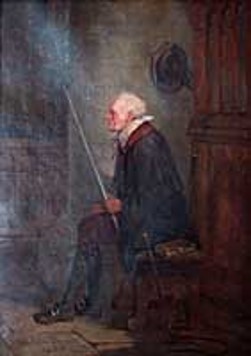 Dog Whipper and Sluggard Waker by Reuben Bussey, 1882
(Wikipedia in public domain)
Southam Heritage Collection is located in the atrium of Tithe Place opposite the Library entrance. Opening times Tuesday, Thursday, Friday and Saturday mornings from 10am to 12 noon. To find out more about Southam’s history, visit our website www.southamheritage.org telephone 07710 012052 or email southamheritage@hotmail.com You can also follow us on Facebook.
Leave A Comment